At Davos 2026, Elon Musk sat across from BlackRock CEO Larry Fink and said: "With robotics and AI, this is really the path to abundance for all." He wasn't alone. Tech leaders and futurists have been selling a similar vision for years - a world where artificial intelligence and automation handle the dirty work while humanity reaps the benefits. More productivity, less scarcity, prosperity for everyone.
It's a compelling story. It's also a lie.
And not because of AI.
I believe AI and robotics could, from a purely technological standpoint, create abundance for all. The machines might very well become capable of doing most human labor. Creating abundance technologically is one challenge. Distributing it fairly is another challenge entirely - and it's one we're already failing at spectacularly.
Here's the uncomfortable truth: if abundant resources and high productivity automatically translated into widespread prosperity, the United States would already be a paradise. We're not waiting for AI to make us productive enough. We're waiting for the political will to share what we already have.
The abundance we could already have
The United States has the largest GDP of any nation on Earth - over $30 trillion and counting, according to the World Bank. We are, by any reasonable measure, phenomenally wealthy. We have the resources, the technology, and the infrastructure.
And yet.
Let's start with healthcare. The United States remains the only country in the developed world without a system of universal healthcare. According to the Commonwealth Fund, the US spends more per capita on healthcare than any other developed nation, $13,432 per person in 2023, outspending every peer country by at least 40%, while being the only one that doesn't guarantee coverage to all its citizens. Americans go bankrupt from medical bills, ration insulin, and die from treatable conditions in the richest country in history.
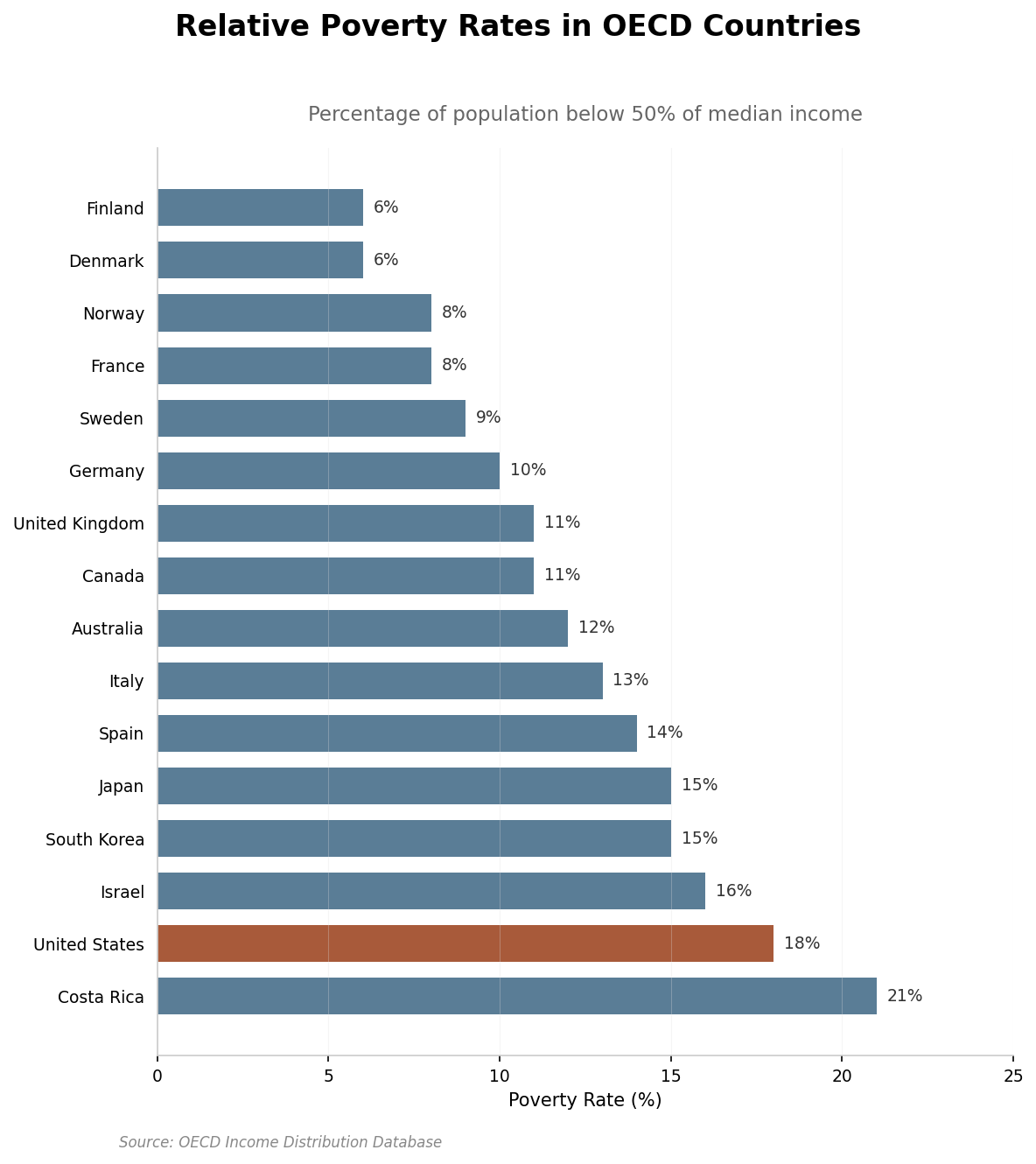
Then poverty. Over 10.6% of the US population, 35.9 million people, lives below the federal poverty line. In 2025, that means an annual income below $15,060 for an individual or $31,800 for a family of four. Try to imagine feeding, housing, and clothing yourself on less than $15,000 a year. Now consider that the United States has the second-highest poverty rate among OECD countries, measured by the percentage of people living below 50% of the national median income. Only Costa Rica ranks higher. One of the richest nations in human history has one of the highest poverty rates among its peers.
Then housing. The US has far more people living unsheltered - on streets and in public spaces, not in temporary housing - than most other Western democracies. According to HUD's 2024 report, 771,480 people experienced homelessness on any given night. Meanwhile, Census data shows roughly 15 million housing units sit vacant, a ratio of about 28 empty homes for every homeless person. The vacancy picture is more complicated than that raw number suggests (many vacant units are seasonal homes, in disrepair, or tied up in probate), but the basic absurdity stands: we have far more shelter than we need and far more people without it than we should.
The gap between what we could do and what we actually do is enormous. If the United States had the political will, we could provide healthcare, childcare, and affordable housing for everyone right now. No superintelligent AI required. No futuristic robots needed. Just a choice to prioritize people over profits.
We don't lack productivity. We lack the will to distribute what we produce.
We've done this before
This isn't speculation. America has implemented exactly the kind of aggressive redistribution that would be necessary to share AI-driven abundance. It was called the New Deal.
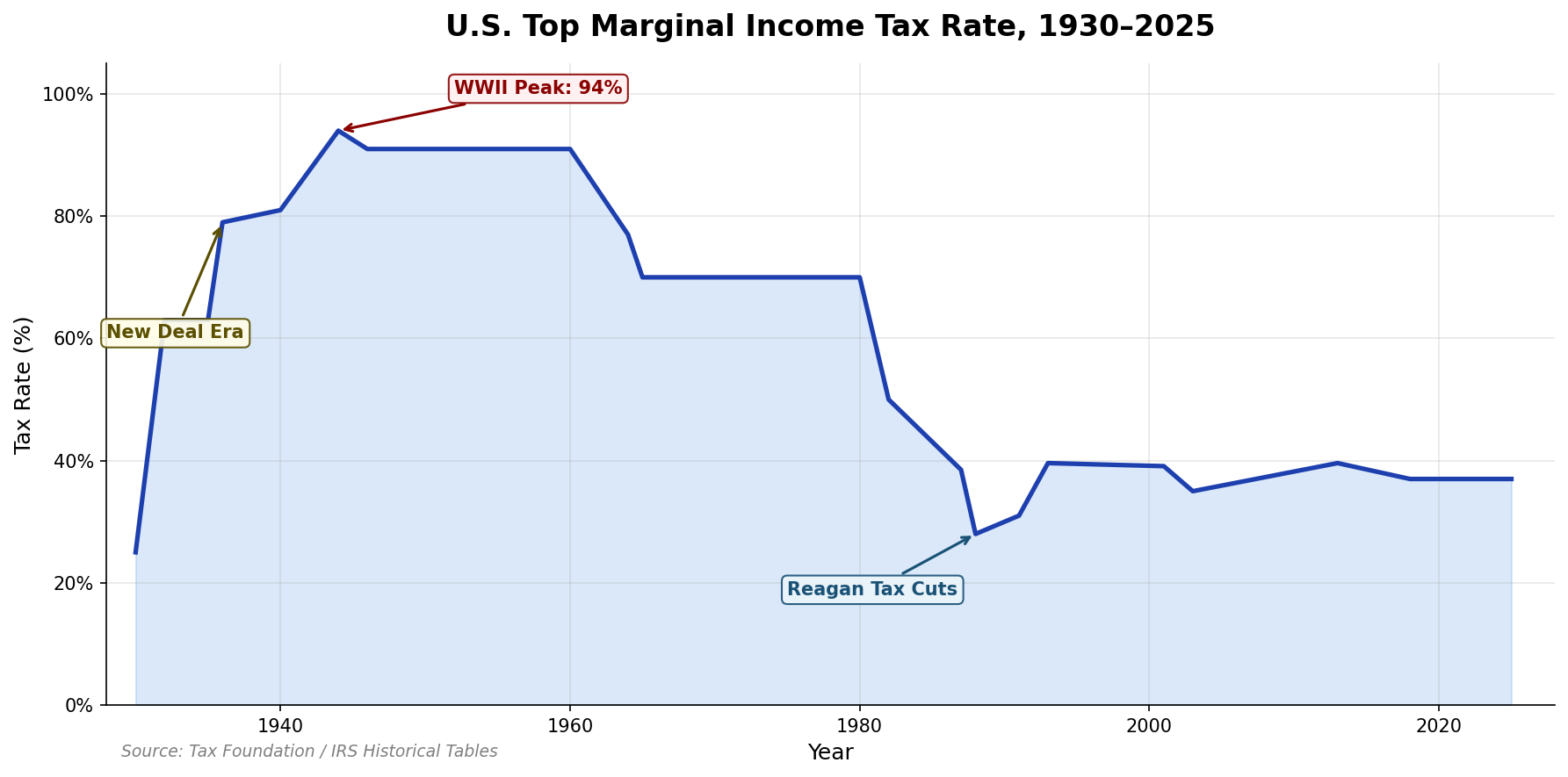
President Franklin D. Roosevelt, through a series of New Deal-era and wartime tax laws, pushed the top marginal income tax rate on the highest earners to extraordinary levels. The Revenue Act of 1935 raised the top marginal rate to 79% on incomes over $5 million (adjusted for combined surtax and normal tax). By 1944, the top rate peaked at 94% on incomes over $200,000. These rates weren't temporary wartime anomalies - top marginal rates stayed above 90% through 1963, nearly two decades.
These weren't fringe policies. They were mainstream American law for decades. And the result? America built the interstate highway system, subsidized higher education for millions through the GI Bill, funded major scientific research, constructed public housing, and created Social Security. The post-war period saw the creation of the American middle class. Inequality was at its lowest. Economic growth was robust. The sky did not fall.
Then came the rollback. Beginning with Reagan in the 1980s, we systematically dismantled this framework. The top marginal rate plummeted from 70% to 28% over just eight years - the lowest it had been since 1925. Capital gains got preferential treatment. Estate taxes were gutted. The result has been exactly what you'd expect: soaring inequality, stagnant wages for workers, and mushrooming fortunes for the already-wealthy.
This wasn't an accident. This was a choice.
Others are doing it right now
We don't need to look only at history. We can look at wealthy nations doing it today.
The Nordic countries - Denmark, Norway, Sweden, Finland - consistently rank among the world's most productive economies. They're technological leaders, highly innovative, with GDP per capita ranging from roughly $55,000 to over $105,000. They're not poor countries making sacrifices. They're rich countries making different choices. They have:
- Universal healthcare that costs far less per capita than the US system while delivering better outcomes across the board
- Virtually no unsheltered homelessness
- Child poverty rates a fraction of America's - Denmark and Finland keep theirs below 10%, compared to over 26% in the US
- Free or heavily subsidized higher education
- Generous parental leave and childcare support
- Strong social safety nets that catch people when they fall
How do they afford this? Progressive taxation that would make American billionaires throw a tantrum. Strong unions and labor protections that give workers bargaining power. Democratic control over key sectors. The result isn't economic stagnation - it's prosperity that's actually shared.
Here's the interesting part: social mobility in Nordic countries is dramatically higher than in the United States. Economists measure this using "intergenerational income elasticity" - how tightly a child's income is tied to their parents' income. Lower numbers mean more mobility. Denmark scores 0.07. The United States scores 0.52 - meaning your parents' income is roughly seven times more predictive of your own income in America than in Denmark.
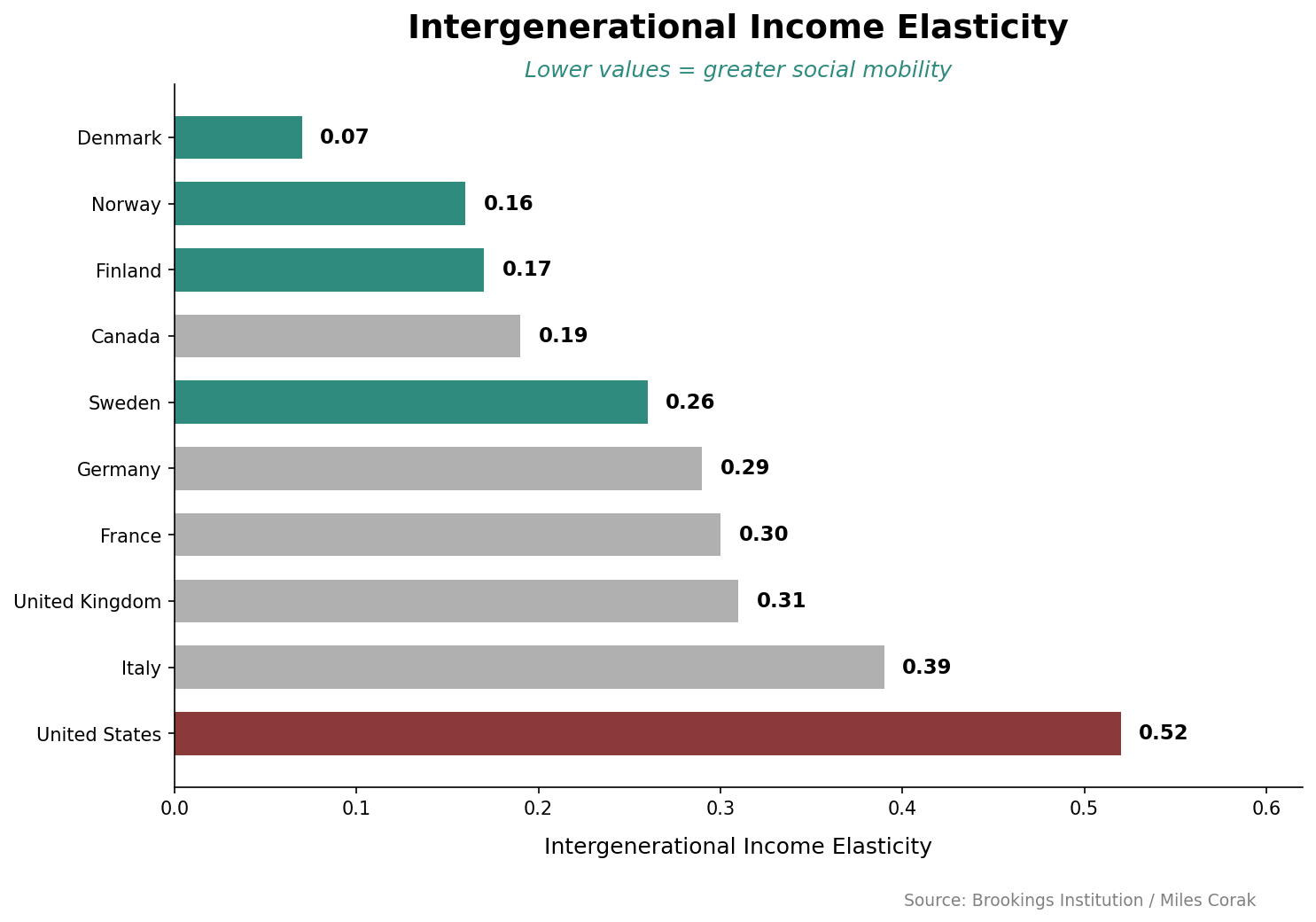
The "American Dream" - rising from poverty through hard work - is statistically more achievable in Denmark than in America.
This isn't some unproven utopian experiment. It's working, right now, in multiple countries with millions of people. The GDP is there. The productivity is there. The wealth is distributed more equitably because of political choices about taxation, labor rights, and social investment. And the people living under these systems are happier for it: in the 2025 World Happiness Report, Finland ranked first for the eighth consecutive year, with Denmark at second, Sweden fourth, and Norway seventh - all four in the global top ten. The Nordic model isn't perfect, and it has its critics. But it proves beyond any reasonable doubt that you can have a highly productive, innovative, wealthy economy while also making sure everyone has healthcare, housing, and education.
It's worth understanding how Nordic countries achieve this, because it didn't happen by accident or goodwill. It happened through specific structural choices that create accountability. Union membership rates of 60-70% give workers genuine bargaining power over wages and working conditions - compared to about 10% in the US. Several Nordic countries require worker representation on corporate boards, so labor interests actually shape strategic decisions instead of being ignored. CEO-to-worker pay ratios are typically 10-15:1; in the US, they regularly exceed 300:1. This compression isn't voluntary - it's enforced through tax policy, labor law, and collective bargaining agreements.
These structures create their own positive feedback loop, the inverse of the one we'll discuss below: lower inequality means less wealthy influence on democracy, which makes it easier to maintain progressive policies, which keeps inequality low. The US had versions of these structures through the mid-20th century. We dismantled them in the 1980s. Reversing course would mean rebuilding them.
The idea that we have to choose between prosperity and equity is a lie. We don't lack examples. We lack will.
The structural problem: how capitalism concentrates wealth
French economist Thomas Piketty spent years documenting a core dynamic of capitalism in his book Capital in the Twenty-First Century: the rate of return on capital (r) tends to exceed the overall economic growth rate (g). His shorthand - r > g - became famous for good reason.
What does this mean in practice? If you already own capital - stocks, real estate, businesses - your wealth grows faster than the overall economy. Faster than wages. Faster than productivity. The rich don't just get richer; they get richer faster than everyone else is getting anything at all.
And this feeds on itself. Capital owners accumulate wealth. They reinvest it. It grows. They accumulate more. Their share of total income and wealth increases relentlessly. They gain political influence. They use that influence to shape tax laws, regulations, and policies in their favor. This makes capital accumulation even easier, which makes them more powerful, which makes the policies even more favorable.
Piketty's thesis has its critics - some economists argue that r > g alone doesn't guarantee rising inequality unless the entire return on capital is reinvested, and others note the relationship has been known in economic theory for decades. These are fair points. But even Piketty's critics generally agree on the big picture: without aggressive intervention - particularly through progressive taxation on wealth and inheritance - capital concentration tends to accelerate. In the mid-20th century, high tax rates kept the loop in check. Since the 1980s, we've removed those constraints, and inequality has exploded.
But don't just take economists' word for it. Look at the data.
Since 1979, productivity in the United States has soared while wages have flatlined. According to the Economic Policy Institute, net productivity grew nearly 60% between 1979 and 2019. Hourly compensation for typical workers? Just under 16%. Productivity grew almost four times faster than pay. Before 1979, the two had risen in near-lockstep for three decades.
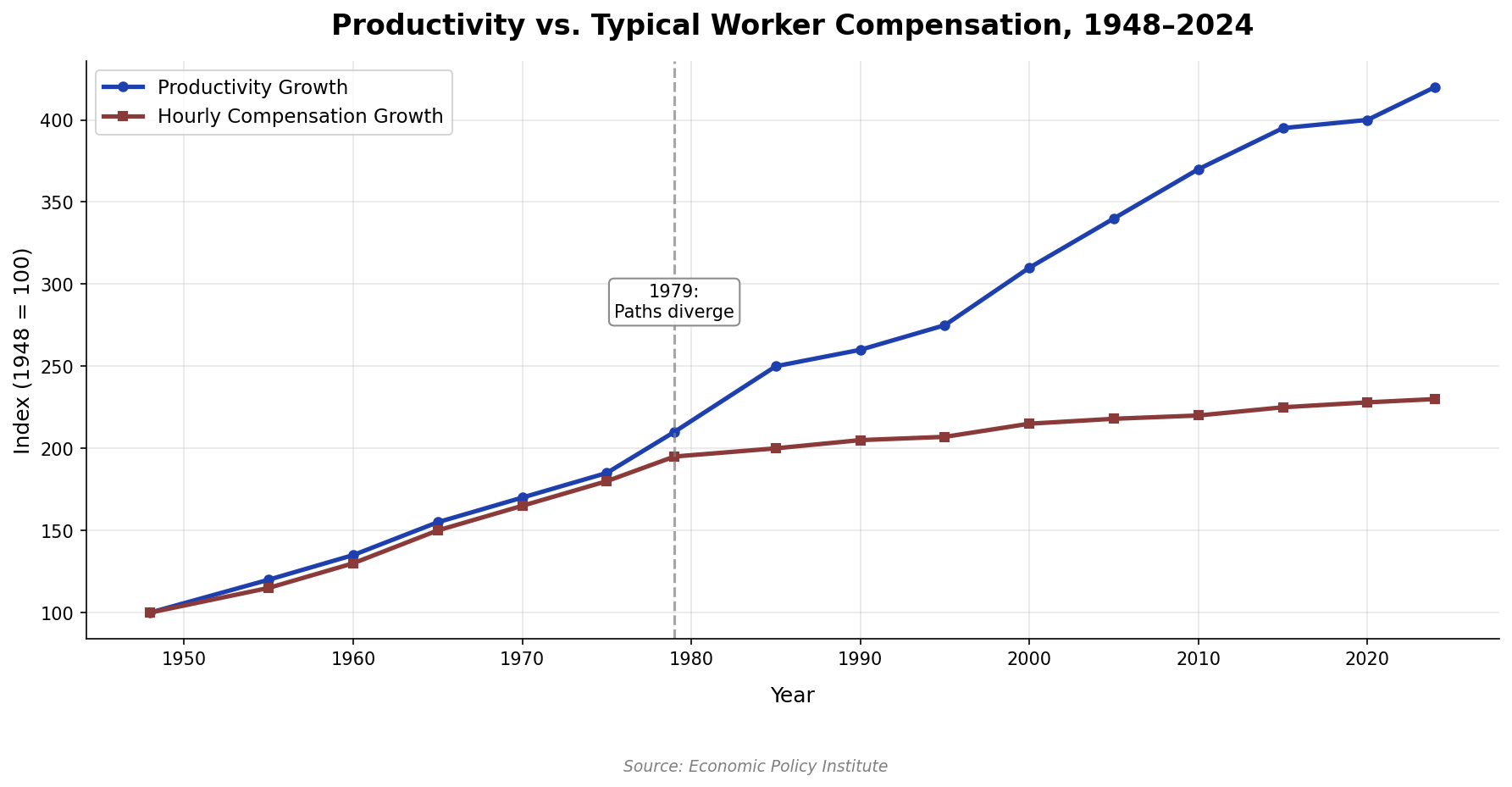
If "a rising tide lifts all boats," wages should have risen alongside productivity. They didn't. The wealth generated by that increased productivity went somewhere - but it didn't go to workers. It went to capital. To executives. To shareholders. To the people who already had the most.
This is the pattern that matters for the AI debate. More productivity does not automatically mean better lives for most people. It means more wealth for whoever controls the means of production. We have forty-five years of data proving this.
The people problem
All of this brings us to the core issue: many of the people who would control AI-driven productivity don't believe in sharing.
Take Elon Musk - the same man promising abundance for all at Davos. What has he actually done when given power over resources that affect human lives?
The USAID catastrophe
In early 2025, Musk played a central role in the dismantling of the United States Agency for International Development (USAID). While President Trump held the formal executive authority, Musk was widely described as a principal architect of the effort through his role leading the so-called Department of Government Efficiency (DOGE). He called USAID a "criminal" organization that should "die". By late February, 90% of USAID contracts and grants had been canceled. All staff were placed on administrative leave. By March, the agency was effectively shuttered - despite federal judges ruling the shutdown "likely violated the Constitution in multiple ways" and watchdog organizations documenting it as illegal.
The consequences were not abstract. They were measured in bodies.
A team led by epidemiologist Brooke Nichols at Boston University built a peer-reviewed model tracking deaths from halted USAID programs - malaria prevention, vaccination campaigns, food aid, maternal healthcare. By late June 2025, her Impact Counter estimated approximately 332,553 people had died as a result, including roughly 224,575 children. Later estimates cited by Atul Gawande of Harvard, using extended modeling, put the toll even higher: around 600,000 deaths - approximately 400,000 of them children.
These are estimates, not confirmed counts, and they rely on epidemiological modeling with inherent uncertainty. But even the most conservative reading of the data points to hundreds of thousands of preventable deaths. People who died because funding for proven, life-saving programs was cut off. Not because the money didn't exist. Not because the programs didn't work. Because Musk and Trump decided they weren't priorities.
Empathy as a bug
How does Musk frame this kind of decision? On a February 2025 episode of the Joe Rogan podcast, Musk said it plainly: "The fundamental weakness of Western civilization is empathy."
To be fair, Musk's full statement was more nuanced - he said he believes in empathy in general but argued for "empathy for civilization as a whole" rather than for individuals, warning against what he called "civilizational suicide." But the practical effect of this worldview is clear: when individual human suffering conflicts with grand systemic goals, then suffering is the result. He called it "the empathy exploit" - framing concern for others as a vulnerability being exploited by bad actors. A bug in the system that needs to be patched out.
This isn't some edgy thought experiment. This is the worldview of the richest person on the planet. The person building AI systems that might soon replace human labor across entire industries. The person who promises that he will usher in an age of abundance.
And he's not alone.
Peter Thiel - billionaire co-founder of PayPal and Palantir - has written that he no longer believes "freedom and democracy are compatible", blaming the extension of the franchise and the welfare state. In 2026, he donated $3 million to fight California's proposed billionaire wealth tax.
Marc Andreessen - venture capitalist behind Andreessen Horowitz, one of the most powerful firms in tech - published his Techno-Optimist Manifesto in 2023. In it, he declared that universal basic income would "turn people into zoo animals to be farmed by the state" and explicitly listed "sustainability," "social responsibility," and "tech ethics" as enemies.
This isn't one or two outliers. This is the prevailing worldview among the tech elite who are building and will control AI. They oppose redistribution, dismiss empathy, and see social safety nets as an insult to human dignity rather than a foundation for it.
These are the people who would decide how the benefits of AI-driven productivity are distributed.
And it's worth noting just how concentrated that control already is. The major AI models are developed by fewer than a dozen companies - OpenAI, Google, Anthropic, Meta, Amazon, Microsoft, and a handful of others. Most are either directly controlled by billionaires or shaped by billionaire investors and board members. Workers at these companies - the engineers and researchers doing the actual work - have remarkably little power over deployment decisions. Meanwhile, these same companies are lobbying heavily against regulation, arguing for "self-regulation" - which is to say, trust us to police ourselves. History's track record on industry self-regulation, from financial services in 2008 to social media data practices, does not inspire confidence.
If AI systems are developed by companies controlled by people who philosophically oppose redistribution, with workers having no say in deployment, and regulators unable to enforce accountability, who exactly will distribute AI abundance? The answer is: nobody - unless we change the power structure itself.
Do you trust them to share?
Why AI won't solve this
The problem we face is not a productivity problem. It's a political power problem.
We already produce enough to house everyone, feed everyone, provide healthcare to everyone. We choose not to. More production won't change that choice. It will just make the people who control production even more powerful.
Look at the productivity-wages chart again. Since 1979, American workers have become dramatically more productive. Did those gains translate into higher wages, better benefits, more security? No. It translated into higher returns for capital owners. The pattern has been consistent for forty-five years: more productivity, same or worse outcomes for workers.
Critics of this argument often point out that previous waves of automation - mechanization, electrification, computerization - eventually created new industries and new jobs, even after painful periods of displacement. Maybe AI will be the same. Maybe it will destroy old jobs and create new ones we can't yet imagine. That's possible. But there are reasons to think this time may be different: AI can automate cognitive and creative work, which was previously considered safe from automation. The speed of displacement may outpace the creation of new roles. And crucially, we lack the political structures - strong unions, robust safety nets, job transition programs - that helped workers survive previous disruptions. Even if AI does eventually create new jobs, the transition period could be devastating without deliberate political intervention.
AI and robotics will accelerate the pattern of concentration, not reverse it. They will displace workers - potentially millions of jobs across entire industries. What happens to those workers? Will there be automatic universal basic income? Guaranteed housing and healthcare? Job retraining at scale?
No. Not unless we fight for it. And right now, the political structures that would enable that fight are badly damaged.
The Citizens United decision in 2010 opened the floodgates to unlimited political spending. Dark money in federal elections went from less than $5 million in 2006 to a record $1.9 billion in the 2024 election cycle, according to the Brennan Center for Justice. Super PAC spending surpassed $4.1 billion in 2024. Billionaires and corporations don't just have more money; they have more political speech, more access, more influence. The democratic process is supposed to be about one person, one vote. In practice, it's one dollar, one vote, and some people have billions of dollars.
The people who will control AI have no incentive to share its benefits. They have the power to prevent policies that would redistribute wealth, and the ideology that says redistribution is theft, empathy is weakness, and inequality is natural.
Side note: Billionaires and their paid corporate media propaganda machines will scream that any amount of "redistribution" is communism, pure and simple. We probably need to take a page from George Lakoff to say that sharing some of the wealth with the people who actually do the work to create it is called "sharing" or "fairness" or some word that doesn't trigger true believers into spittle-flinging mania.
Why would they voluntarily create abundance for all?
The path we're actually on
Here's what's more likely to happen without political change:
AI and robotics will dramatically increase productivity. The benefits of that productivity will flow overwhelmingly to capital owners - the people who own the AI systems, the robots, the data, the infrastructure. Workers displaced by automation will struggle to find new employment. Without strong social safety nets - which we don't currently have and show no political will to build - they'll fall into poverty.
Inequality will accelerate. The gap between the wealthy and everyone else will become a chasm. Social problems - homelessness, crime, political instability - will intensify.
Eventually, the contradictions will become unsustainable. You can't have a functioning economy when nobody can afford to buy anything because they don't have jobs. You can't have a stable society when most people are struggling to survive while a tiny elite lives in unimaginable luxury.
Something will break.
Meaningful redistribution never happens because the powerful suddenly develop a conscience. It happens when they have no other choice. The New Deal didn't happen because FDR was a nice guy. It happened because the alternative - with organized labor in the streets, a radicalized working class, and the specter of revolution - was far worse for everyone in power.
If AI does eventually lead to abundance for all, it may be because it first triggered an economic catastrophe severe enough to force fundamental political change. The people who currently hold power will not give it up willingly. They'll have to lose it.
That's a dark irony: the path to AI abundance might run through AI-driven collapse.
What real change would require
But it doesn't have to go that way. We know what works. We've done it before. Other countries are doing it now. Imagining a world where AI actually creates abundance for all requires imagining a different set of political choices - and then fighting for them.
Aggressive progressive taxation, not just on income but on wealth and inheritance. If capital returns exceed economic growth, we need mechanisms to redistribute that excess. Otherwise, it concentrates indefinitely. The New Deal proved this works. The Nordic countries prove it works today.
Campaign finance reform, because democracy cannot function when political influence is for sale. We need to break the connection between wealth and political power, or policies will always serve the wealthy. The explosion of dark money since Citizens United has made this more urgent, not less.
Universal basic services: healthcare, housing, education, childcare guaranteed as rights, not market commodities. If AI makes us vastly more productive, the baseline standard of living should rise for everyone, not just those who own the robots.
Democratic control over AI deployment, because decisions about how AI is developed and used shouldn't be made solely by tech companies and billionaires. There need to be mechanisms for public input, democratic oversight, and real accountability.
Strong labor protections and collective bargaining, because workers need power to negotiate for their share of productivity gains. Without unions and labor laws, they have no leverage. The divergence between productivity and wages began precisely when union membership started declining.
These aren't fantasy policies. We've implemented versions of them before. Other countries implement them now. They work. The question is whether we have the political will to fight for them.
Choose action over catastrophe
The question isn't "Can AI create abundance?"
The answer to that is probably yes. Technologically, AI and robotics could absolutely produce enough for everyone to live comfortably. The machines can probably do the work.
The real question is: Who will control it, and how will the benefits be distributed?
That's a political question, not a technological one.
We have decades of evidence that technology alone doesn't solve inequality. Productivity has soared since 1979 while wages stagnated. We have the GDP to end poverty and homelessness right now. Other countries prove it's possible to combine high productivity with shared prosperity. We don't do it because we choose not to - or more precisely, because the people with power choose not to.
AI will follow the same pattern unless we change the underlying power structures. The billionaires promising AI abundance are the same people who oppose redistribution, dismiss empathy as weakness, and use their wealth to shape policy in their favor. Waiting for them to voluntarily share is waiting for something that simply won't happen.
So what do we do?
We organize. Labor unions, tenant unions, community organizations, political movements - collective power is the only counter to concentrated wealth. The New Deal didn't happen because FDR was generous. It happened because organized labor and social movements made continuing with business as usual impossible.
We make it a voting issue. Politicians respond to what voters demand. Right now, donors have more influence. But when enough voters make something non-negotiable - when they show up in primaries, when they vote out incumbents who block change - politicians move. We've seen this work on issues from marriage equality to marijuana legalization.
We build alternative institutions. Worker cooperatives, mutual aid networks, credit unions, public banks, community land trusts. We don't have to wait for the government to act to start building economic structures that distribute power and wealth differently.
We fight for immediate wins that shift power. Higher minimum wages, unionization drives, progressive local taxes, rent control, Medicare expansion. Each win builds momentum and shows that change is possible.
We tell a different story. The narrative that inequality is natural, that billionaires are job creators, that government is always wasteful - these are stories that serve power. We need to tell true stories: about how we built prosperity before, about how other countries do it now, about who benefits from the current system and who pays the price.
If this feels abstract or utopian, consider that modest versions of these strategies have worked recently. Cities that passed $15 minimum wages were widely predicted to suffer job losses; instead, employment generally held steady while low-wage workers saw meaningful income gains. Unionization drives at Amazon warehouses, Starbucks locations, and tech companies have won better conditions and higher pay, not because employers volunteered, but because workers organized and fought for it. Community land trusts in dozens of cities have removed land from speculative markets, permanently keeping housing affordable. None of these are perfect. All encountered fierce opposition. But they show that political change is achievable when people commit to it.
The obstacles are real. Money dominates politics. Media is concentrated and owned by billionaires. Many people are exhausted, alienated, or convinced nothing can change. The path to structural reform is long and uncertain.
But history isn't a spectator sport. Change happens because people decide it must and then put in the work. The New Deal. Civil rights. Labor rights. Women's suffrage. None of these were inevitable. All of them required ordinary people organizing, protesting, striking, voting, and refusing to accept the status quo.
We can wait for an AI-driven economic catastrophe to force change. That might happen. Crises do sometimes create opportunities for transformation.
Or we can organize now, build power now, fight for change now - before millions of people lose their jobs and livelihoods, before inequality becomes even more extreme, before the political situation gets even more dire.
The choice isn't between accepting techno-optimist promises and waiting for collapse. The choice is between organizing for the future we want or letting others decide it for us.
Technology won't save us. Billionaires won't save us. Only we can save ourselves - by building the political power to ensure that when AI does make us vastly more productive, everyone benefits, not just the people who own the robots.
The fight starts now. The question is whether we're willing to do what it takes.
This is the first in a series examining AI, automation, and economic justice. Future pieces will explore specific policy solutions, successful organizing models, and the role of tech workers in shaping how AI is deployed.
Header photo by MART PRODUCTION on Pexels.
Sources
-
World Economic Forum. "Elon Musk at Davos 2026: Why Technology Could Shape a Future of Abundance." January 2026. https://www.weforum.org/stories/2026/01/elon-musk-technology-abundant-future-davos-2026/
-
World Bank. "GDP (Current US$)." https://data.worldbank.org/indicator/NY.GDP.MKTP.CD
-
Commonwealth Fund. "U.S. Health Care from a Global Perspective, 2022." January 2023. https://www.commonwealthfund.org/publications/issue-briefs/2023/jan/us-health-care-global-perspective-2022
-
OECD. "Health at a Glance 2025: Health Expenditure Per Capita." https://www.oecd.org/en/publications/2025/11/health-at-a-glance-2025_a894f72e/full-report/health-expenditure-per-capita_affe6b0a.html
-
U.S. Census Bureau. "Poverty in the United States: 2024." https://www.census.gov/library/publications/2025/demo/p60-287.html
-
U.S. Department of Health and Human Services. "2025 Poverty Guidelines." https://aspe.hhs.gov/topics/poverty-economic-mobility/poverty-guidelines
-
OECD. "Society at a Glance 2024: Income Poverty." https://www.oecd.org/en/publications/society-at-a-glance-2024_918d8db3-en/full-report/income-poverty_53d4eac1.html
-
United Way NCA. "Vacant Homes vs. Homelessness by City." https://unitedwaynca.org/blog/vacant-homes-vs-homelessness-by-city/
-
Tax Foundation. "Historical Income Tax Rates and Brackets, 1862-2021." https://taxfoundation.org/data/all/federal/historical-income-tax-rates-brackets/
-
Economic Policy Institute. "The Productivity-Pay Gap." https://www.epi.org/productivity-pay-gap/
-
Brookings Institution. "International Comparisons of Economic Mobility." https://www.brookings.edu/wp-content/uploads/2016/07/02_economic_mobility_sawhill_ch3.pdf
-
Economic Policy Institute. "Countries Investing More in Social Programs Have Less Child Poverty." https://www.epi.org/publication/countries-investing-more-in-social-programs-have-less-child-poverty/
-
Federal Reserve Bank of New York. "A Discussion of Thomas Piketty's Capital in the Twenty-First Century." July 2015. https://libertystreeteconomics.newyorkfed.org/2015/07/a-discussion-of-thomas-pikettys-capital-in-the-twenty-first-century-by-how-much-is-r-greater-than-g/
-
Foreign Policy. "Trump, Musk's USAID Shutdown, Explained." February 2025. https://foreignpolicy.com/2025/02/05/usaid-trump-musk-rubio-state-department/
-
Boston University. "'It's Unacceptable': BU Mathematician Tracks Deaths from USAID, Medicaid Cuts." https://www.bu.edu/articles/2025/mathematician-tracks-deaths-from-usaid-medicaid-cuts/
-
Harvard T.H. Chan School of Public Health. "USAID Shutdown Has Led to Hundreds of Thousands of Deaths." https://hsph.harvard.edu/news/usaid-shutdown-has-led-to-hundreds-of-thousands-of-deaths/
-
NPR. "A Judge Says the USAID Shutdown Was Likely Unconstitutional." March 2025. https://www.npr.org/2025/03/18/nx-s1-5332274/judge-ruling-usaid-shutdown
-
American Oversight. "Donald Trump and Elon Musk's Illegal Dismantling of USAID." https://americanoversight.org/investigation/donald-trump-and-elon-musks-illegal-dismantling-of-usaid/
-
Snopes. "Musk Said 'The Fundamental Weakness of Western Civilization Is Empathy.'" https://www.snopes.com/fact-check/elon-musk-empathy-quote/
-
Peter Thiel. "The Education of a Libertarian." Cato Unbound, April 2009. https://www.cato-unbound.org/2009/04/13/peter-thiel/education-libertarian/
-
Fortune. "Peter Thiel Makes His Biggest Donation in Years to Help Defeat California's Billionaire Wealth Tax." January 2026. https://fortune.com/2026/01/14/peter-thiel-makes-his-biggest-donation-in-years-to-help-defeat-californias-billionaire-wealth-tax/
-
Marc Andreessen. "The Techno-Optimist Manifesto." Andreessen Horowitz, October 2023. https://a16z.com/the-techno-optimist-manifesto/
-
VentureBeat. "Marc Andreessen Publishes 'Techno-Optimist Manifesto,' Names Enemies Including ESG, Trust and Safety." https://venturebeat.com/ai/marc-andreessen-publishes-techno-optimist-manifesto-names-enemies-including-esg-trust-and-safety/
-
Brennan Center for Justice. "Dark Money Hit Record High of $1.9 Billion in 2024 Federal Races." https://www.brennancenter.org/our-work/research-reports/dark-money-hit-record-high-19-billion-2024-federal-races
-
OpenSecrets. "By the Numbers: 15 Years of Citizens United." January 2025. https://www.opensecrets.org/news/2025/01/by-the-numbers-15-years-of-citizens-united/
-
Wiley Online Library. "The Death of USAID: How Elon Musk and Donald Trump Ended America's Foreign Aid Agency." https://onlinelibrary.wiley.com/doi/10.1002/pad.70011
-
OECD. "Trade Unions and Collective Bargaining." https://www.oecd.org/en/topics/trade-unions-and-collective-bargaining.html
-
OpenSecrets. "As Washington Moves Toward Regulating AI, Big Tech Is Spending Big to Shape Those Rules." August 2023. https://www.opensecrets.org/news/2023/08/as-washington-moves-toward-regulating-ai-big-tech-is-spending-big-to-shape-those-rules/
-
World Happiness Report 2025. https://www.worldhappiness.report/





Use the share icon here if you liked it.
Thanks!