When you first started using Facebook, suddenly friends and family who you hadn't seen in years were
closer! It was even free!
This was before you realized that you were the product. Remember the Cambridge Analytica scandal?
To refresh your memory:
In the mid 2010s, a British political consulting firm called Cambridge Analytica obtained data from tens of millions of Facebook users and used it for targeted political advertising, including work related to the 2016 Trump campaign. The sneaky scheme they used to get the data came from an academic-style personality quiz app created by researcher Aleksandr Kogan. Facebook’s APIs let the app harvest not only users' data but also much of their friends’ data, even though those friends had never consented.
Many people bailed out then, and the rest of us learned we should pore over every change Facebook
makes to settings (which happens constantly), closing as many security holes as we can.
The trouble was (and is) that many of your friends and family are only on Facebook, and you'll
never get them to move anywhere else en masse. Do you really want to use 17 different social
media apps to try to keep up with them all, or lose touch with them again? Does Aunt Margaret really
mean that little to you, that you'll give up on her over a bit of targeted advertising from
Russian propaganda trolls? Shame on you!
Ah, the good old days.
Things are so much worse now.
These days you're lucky to see what your friends and family are up to at all, if you can spot them
amid the mountain of paid content, ads, propaganda, conspiracy theories, and "suggested" crap
from people you've never heard of. In fact, you may never see your friends' posts - and they
may never see yours.
Cory Doctorow has a name for what happened to Facebook (and Amazon, and Google, and pretty much every
platform you've loved and then quietly grown to resent). He calls it enshittification.
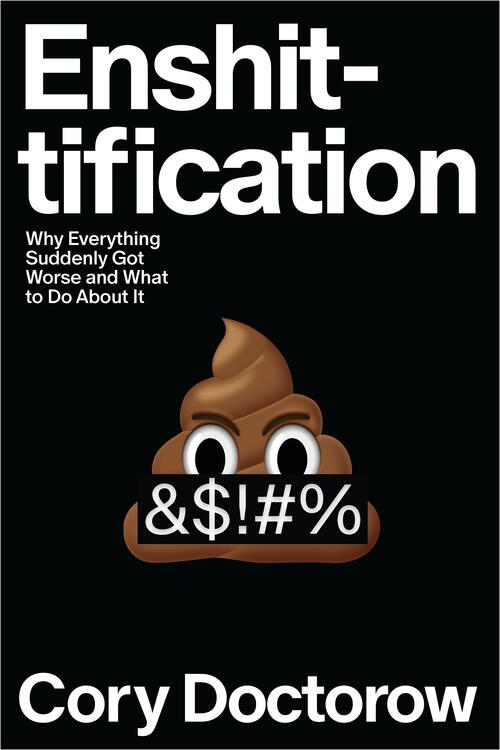
Platforms start by being good to users to attract them, then they shift to squeezing
users to benefit business customers (advertisers), then finally squeeze everyone to benefit shareholders.
The end result is a product that's technically still "free" but costs you something
worth more than money: your time, your attention, and eventually your faith in humanity.
Why Does This Keep Happening?
It's not just due to greedy billionaires (though, sure, those too). As
Nicole explains really well, simply maintaining
a steady, multi-billion-dollar profit year after year is viewed by Wall Street as stagnation. Stock
prices have to go up forever. Hefty profits that merely continue at the same rate isn't growth — it's
failure. And it's not just the ultra-wealthy driving this. The people who manage your 401k and IRA
are in there too, quietly demanding that the line go up. That's their whole job. We're all tangled up in this thing.
The result, for Facebook in particular, is a platform that started as a way to stay connected with
people became one that realized outrage and addiction are far more engaging than connection,
and engagement is what sells ads. So now you get more of whatever makes you feel shitty and keeps
you doom-scrolling.
So Why Are You Still There?
You're there because you are willing to put up with a LOT for a little time with those you love.
(If someone important to you has given you a little speech about
how they don't use Facebook, that's their choice. You do you.)
The truth is that there are real reasons people stay:
- Your aunt is only on Facebook, and she posts the best family photos.
- A group you care about organizes there and hasn't moved.
- You've tried to get people to join Bluesky (I'm @ronlunde.com,
come find me) and been met with polite silence. People are tired. They don't need yet another thing to keep track of.
- Different platforms have different unspoken rules and it takes time to learn them.
Sticking it out is not weakness. That's your own rational tradeoff between "this platform is terrible"
and "my people are here."
The good news is, if you decide to stick with it, you can make your own experience a bit less shitty.
Let's Deshittify
A quick note: this isn't Doctorow's fix. His book is about systemic change — regulation, legislation,
breaking up monopolies. We need to do that! This is just about your personal experience, today.
Think of it as temporary harm reduction, not revolution.
You don't need to do everything on this list. Pick two or three things and you'll see a real
difference.
Caveat: this is how things work now, as far as I can tell. Facebook changes things all
the time, so don't give up if this exact things doesn't work - go find out how to do it with
whatever changes they've made.
The single biggest move: stop using the Home feed
Facebook's default Home feed is the one fully optimized to make you miserable. But buried in the
app — and easily missed — is a Friends feed that shows posts from people you actually know,
roughly in order, without the algorithmic slop.
On mobile: tap the menu icon (three lines) → Feeds → Friends. If you want it easier to
find, go to Settings → Navigation Bar → Customize the bar, and pin the Friends tab so it lives
on your main screen permanently. On desktop, look for Feeds in the left sidebar.
Many people report that this alone feels like "old Facebook." It's not, but it's a lot
closer.
Build a Favorites list
Facebook lets you designate up to 30 people as Favorites (Settings & Privacy → Feed → Favorites).
What they don't tell you about this is: it's reciprocal. Marking someone as a Favorite doesn't
just push their posts higher in your feed — the algorithm also starts surfacing your posts higher in
their feed. It's the closest thing to saying "this person matters to me" in a language Facebook
actually understands. Sort of. Ish.
Tell the algorithm to knock it off (desktop setup, ~5 minutes)
If you mostly use Facebook on a desktop browser, two things are worth doing once:
-
Install an ad blocker. uBlock Origin is free, trusted, and
dramatically reduces junk. For something more targeted, F.B. Purity
is a Facebook-specific extension that strips out sponsored posts, suggested reels, and sidebar
noise with surgical precision. Either one changes the experience noticeably. Neither one may
continue to work forever, since Facebook doesn't like it when you block their ads.
-
Nuke your ad preferences. In Facebook Settings, go to Ads → Ad Settings and set
everything to "Not allowed." You'll still see ads — Meta's not that generous — but they'll be
less aggressively targeted. While you're in there, go to Ad preferences → Activity information
from ad partners and turn that off too. You'll feel slightly less like someone is breathing
on the back of your head.
A few habits worth picking up
Hide things without explaining why. The "..." menu lets you hide any post or ad. Just hide it
and move on — don't click "this isn't relevant to me" or explain your reasoning. Engaging with the
explanation teaches the algorithm about your preferences. Be inscrutable. You're less likely
to be scruted.
Unfollow ≠ Unfriend. You can unfollow someone (they vanish from your feed) while staying
friends (they can still see your posts, you can visit their profile). It's the Facebook equivalent
of muting someone's texts without the awkward conversation. Very civilized and dramatically
underused.
Comments beat likes. A like barely registers. A comment — especially a real one, more than a
few words — is a strong signal that the algorithm notices. If you want to actually stay connected
to someone, comment on their posts occasionally. And when people comment on yours, reply. That
"active conversation" is a signal that extends how many people see your post.
Set a timer before you open it. Not after. This sounds stupidly simple because it is. It
also works, which is damn annoying isn't it?
Put external links in the first comment, not the post. Facebook suppresses posts with
outbound links — it wants to keep you on-platform. Post your text, then drop the URL in the
comments and mention it's there. Your reach improves noticeably.
Get offline contact info for people who matter. If Facebook disappeared tomorrow — which isn't
impossible — could you still reach the 10 people you most want to stay in touch with? Phone numbers.
Email addresses. Worth getting while you're thinking about it. (Or verifying - people change phone
numbers and email addresses once in a while.)
If you see misinformation, don't argue — just link. You're not going to win a comment thread
debate. Just drop in a quiet link to Snopes or
AP Fact Check, framed as "interesting additional reading"
rather than "you're wrong."
Don't feed the trolls. - 'nough said.
Don't Be Embarrassed
Using Facebook isn't a character flaw. You don't have to make excuses for it, and you don't
have to defend it against people who are proud they quit. Some of those people
found something better. Some of them have other reasons, and they don't need
you questioning them either. (Not that you would.)
If you're still on Facebook, you're there because the people you care about are there. That's a
very good reason. You will never love the platform — just use it on your own terms, for your reasons,
without letting it use you back quite so much.
For many of us, that's worth a little effort.
Postscript
(Added on Thursday, June 25, 2026)
Meta itself appears poised to become the most profitable advertising company
in the world (surpassing Google) while simultaneously becoming a Mordor-like hellhole
for its employees. If you're curious, this excellent video from El explains.
(Added on Friday, July 10, 2026)
There's a recent YouTube video from Proton that has great information on Meta and privacy:
Every Way Meta Tracks You, and How to Fight Back
More DIY Deshittification coming soon — Amazon, Google, other social media, and some other things
that have been getting shittier while we weren't paying attention.


Use the share icon here if you liked it.
Thanks!